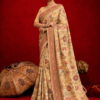
The temple-town cotton with the Nizam border.
What it’s made of
Mangalgiri cotton, also spelled Mangalagiri, comes from Mangalagiri, a temple town in Guntur district of Andhra Pradesh, between Vijayawada and Guntur. It is woven from sturdy, fine cotton yarn. Mangalagiri weavers also make silk and silk-cotton sarees, but the cotton is what the town is known for.
A short history
Mangalagiri is known for the Lord Panakala Narasimha Swamy temple, and weaving has long gone hand in hand with the town. Its sarees and fabrics were registered with a Geographical Indication (GI) tag, which protects the name for cloth made in the Mangalagiri region.
What makes it Mangalgiri
- The Nizam border. A woven border with tiny inverted checks and fine dots, usually in zari. This is the signature of the weave.
- Plain or striped body. Often a solid colour or a simple stripe, which lets the border stand out.
- Durable cotton. The cloth is made to be worn often and to last.
What it feels like
Mangalgiri has a slightly firmer hand than plain cotton and feels craft-made rather than mill-produced. It is cool and breathable at 100–130 GSM, a comfortable mid-weight that softens with washing.
How it wears
Mangalgiri drapes well and holds pleats consistently. The border gives it a clean finish, so it looks put-together without being dressy. It is an easy office fabric.
How to tell real Mangalgiri
- The Nizam border should be woven in, not printed. Printed Nizam borders are a common imitation.
- Pure cotton feels cool and matte. A warm, shiny feel suggests a blend.
- A GI tag confirms the region. Ask the seller how the saree was woven.
How to wash it
- Wash: Machine wash cold on a gentle cycle. Wash a new saree separately for the first two or three washes in case a colour bleeds.
- Dry: Hang in the shade.
- Iron: Medium heat while slightly damp. The texture recovers fully.
More in Caring for cotton sarees.
A note on weight
100–130 GSM. A comfortable mid-weight cotton.
Where it comes from
Mangalagiri, Guntur district, Andhra Pradesh. GI-tagged.
Best for
- Daftar: excellent office fabric
- Rozana: daily wear with visible craft character
- Anyone who wants a natural, unprocessed look
If you like Mangalgiri, read next
Or browse our sarees.
Mangalgiri Cotton: quick answers
What is Mangalgiri cotton?
A cotton handloom fabric from Mangalagiri in Andhra Pradesh, known for its woven Nizam border.
What is the Nizam border?
A zari border with tiny inverted checks and fine dots. It is the best-known mark of Mangalgiri sarees.
Is Mangalgiri good for office wear?
Yes. It drapes well, holds pleats and looks deliberate without being dressy.
How do I wash a Mangalgiri saree?
Machine wash cold on a gentle cycle, separately at first, then hang in the shade and iron on medium heat while slightly damp.
Is Mangalgiri the same as Mangalagiri?
Yes. Both spellings refer to the same town and fabric.
Does Mangalgiri have a GI tag?
Yes. Mangalagiri sarees and fabrics are GI-registered.