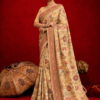
Silk warp, cotton weft, made in the same town for centuries.
What it’s made of
Maheshwari comes from Maheshwar, a town on the banks of the Narmada in Khargone district, Madhya Pradesh. It is traditionally woven with silk in the warp and fine cotton in the weft. That mix gives a soft sheen without the weight of a full silk saree. Maheshwari is a silk-cotton fabric, not pure silk.
A short history
The weave is linked to Ahilyabai Holkar, the Holkar ruler of Indore, who made Maheshwar her capital in 1767. By local tradition she invited skilled weavers to the town and had sarees made as gifts for royal guests. The craft declined over time. It was revived from the late 1970s through the Rehwa Society, a non-profit set up in the fort at Maheshwar by Richard and Sally Holkar to give weavers work and bring the cloth to a wider market. Maheshwar sarees and fabrics are registered under India’s Geographical Indication (GI) law, with the application filed in 2010.
What makes it Maheshwari
- The reversible border. The border is woven so it looks finished on both sides. This is the best-known mark of the weave.
- Stripes and checks. Many Maheshwari sarees have a plain, striped or checked body with a contrasting border and pallu.
- Light zari. Where zari is used, it is usually in the border and pallu, not all over.
What it feels like
Softer and more fluid than Chanderi, with a natural weight that drapes well. The silk warp gives a lustre that is present but quiet. It is a comfortable weave to wear through a long working day.
How it wears
Maheshwari drapes with more fluidity than Chanderi and more substance than mulmul. It holds pleats well and stays in place through long hours of wear.
How to tell real Maheshwari
- Check that the border is reversible, with the same design on both sides.
- The body should feel light and soft, not heavy or stiff.
- A sheen that looks glassy and hard is a warning sign.
- A GI tag confirms origin. It does not grade quality, so ask the seller how the saree was woven.
How to wash it
- Wash: Hand wash cold with a mild, pH-neutral detergent. Wash a new saree separately the first couple of times in case a colour bleeds.
- Dry: Lay flat in the shade. Do not wring.
- Iron: Reverse side, low setting. Use a pressing cloth over zari.
More in Caring for Chanderi and Maheshwari sarees.
A note on weight
70–90 GSM. Light, but with enough drape weight to give it presence.
Where it comes from
Maheshwar, Madhya Pradesh, GI-tagged. The revival is associated with the Rehwa Society.
Best for
- Tyohar: festive occasions
- Daftar: formal professional wear
- Anyone who wants handloom tradition in an office-appropriate fabric
If you like Maheshwari, read next
Or browse our sarees.
Maheshwari: quick answers
What is Maheshwari?
A silk-cotton fabric from Maheshwar, Madhya Pradesh, traditionally woven with a silk warp and a cotton weft.
Is Maheshwari pure silk?
No. Traditional Maheshwari mixes silk and cotton. That is why it is lighter and easier to care for than a full silk saree.
What is special about the Maheshwari border?
It is reversible. The border design looks finished on both sides of the saree.
Who started Maheshwari weaving?
The tradition is linked to Ahilyabai Holkar, who made Maheshwar her capital in 1767. It was revived in the late 1970s by the Rehwa Society.
How do I wash a Maheshwari saree?
Hand wash cold with a pH-neutral detergent, lay flat in the shade without wringing, and iron on the reverse side on a low setting.
Is Maheshwari good for the office?
Yes. It is light, fluid and holds pleats, with a quiet lustre.
Does Maheshwari have a GI tag?
Yes. Maheshwar sarees and fabrics are registered as a Geographical Indication, protecting the name for cloth woven in Maheshwar.